
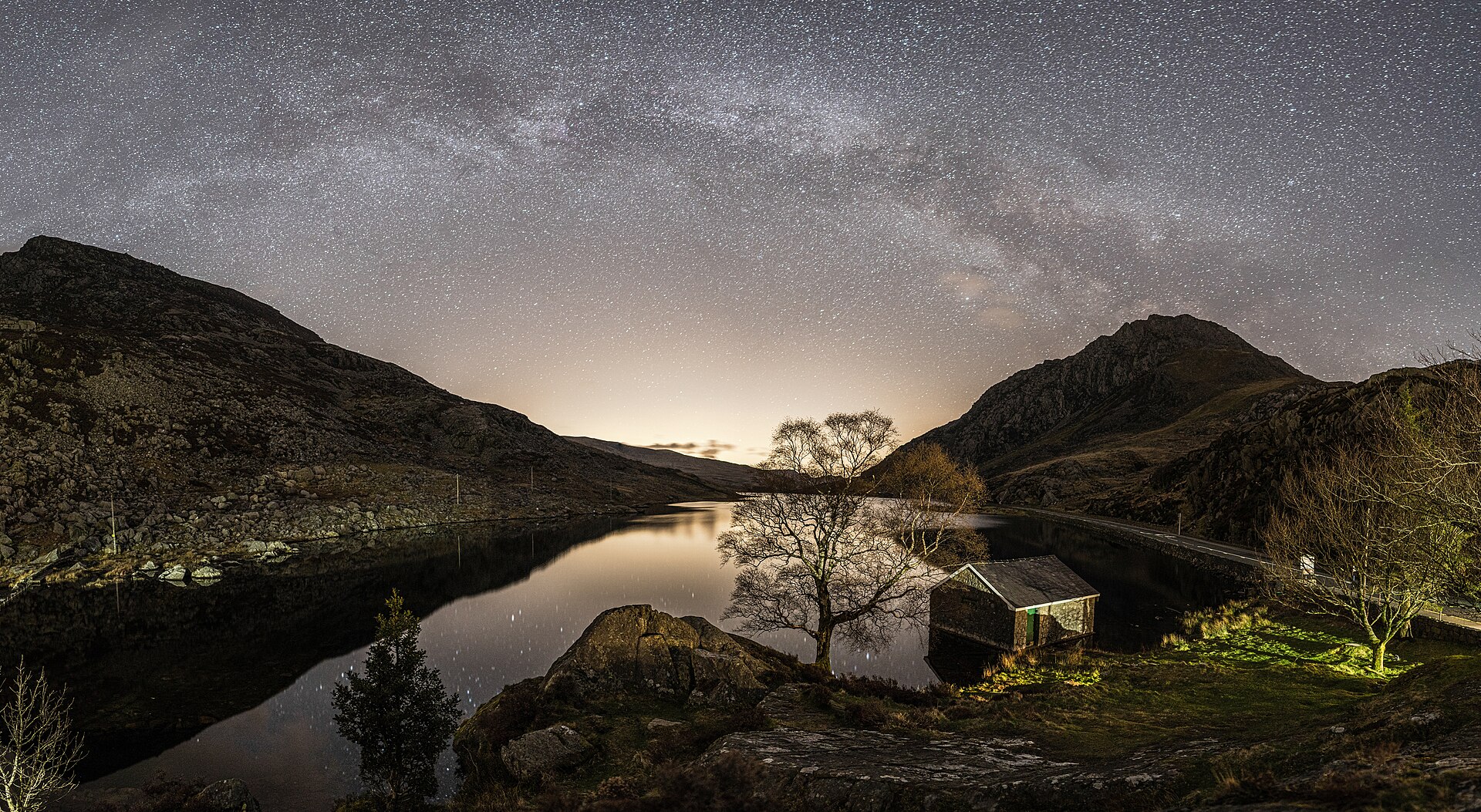
Most of the Llŷn’s tourism content, understandably, is about daylight — beaches, walks, harbours. But the peninsula has a genuinely underused asset after dark: with no large towns and very little light pollution along most of its length, the western half of the Llŷn offers some of the clearest, darkest night skies anywhere in Wales.
The best spots are the obvious ones once you think about it: the wide-open headland at Uwchmynydd beyond Aberdaron, the beach car parks at Porth Oer and Porth Iago once the day visitors have left, and the higher ground around Yr Eifl and Mynydd Cilan, all well away from the sodium glow of Pwllheli or Nefyn. On a clear, moonless night, the Milky Way is visible to the naked eye from most of these spots — something a lot of visitors, especially those from cities, have genuinely never seen before.
This is a trail that works best paired with something else rather than standing alone: a late dinner in a harbour village, then a short drive out to a dark-sky spot for an hour before bed. It also gives shoulder-season and off-peak visitors — the exact audience the site most needs to attract outside the summer crush — a genuine reason to come in autumn or early spring, when the nights are long and the skies are often at their clearest.
Practically, this is a low-cost article to produce and a genuinely novel one: very little existing Llŷn tourism content covers stargazing at all, which makes it a strong candidate for search visibility as well as a nice, shareable, photogenic angle for social media — a long-exposure shot of the Milky Way over Porth Iago would do more for the site’s Instagram than another beach photo.
The Llŷn itself doesn’t carry an official dark sky designation, but it sits right alongside Eryri National Park’s International Dark Sky Reserve, one of only a handful in the world, and benefits from much the same lack of light pollution along its own coastline — there’s very little between the peninsula’s villages and a genuinely dark sky. The best conditions come on a clear, moonless night, so checking the moon phase before planning a trip matters as much as checking the weather forecast; a few days either side of a new moon gives the darkest skies, while a full moon will wash out all but the brightest stars. Fewer streetlights and a wide, unobstructed western horizon are the two things to look for in a spot, which is exactly why an empty beach car park after dark, used considerately and left as you found it, often beats a formally signposted viewpoint.
One practical note worth including: away from lit car parks, a head torch, warm layers even in summer, and a bit of caution on cliff-edge paths in the dark are worth flagging to visitors unfamiliar with truly unlit countryside.
Photo: The Milky Way over Llyn Ogwen, Eryri (Snowdonia) — John Badham / Wikimedia Commons (CC BY-SA 4.0). Llyn Ogwen is a lake in Eryri, not on the Llŷn Peninsula itself, but within the same dark-sky landscape.